



Respectful Toddler Discipline: Practical Tips for Parent
Let’s be real for a second. Before I had kids, I had all the answers. I remember watching a mom in the grocery store calmly negotiate with her screaming two-year-old over a bag of gummy bears, and I thought, "Wow, my kid will never act like that."
Fast forward a few years, and there I was—hiding in the cereal aisle while my toddler performed what can only be described as an exorcism over a box of fruit snacks. I felt defeated, exhausted, and totally clueless.
In those early years, I quickly learned that there is a massive difference between punishing a child and disciplining them. After countless research deep-dives, chats with child psychologists, and a whole lot of trial and error (mostly error), I finally figured out the best ways to discipline toddlers. And spoiler alert: it has nothing to do with yelling or time-outs. It has everything to do with connection.
Understanding the Toddler Mind: Why "Bad Behavior" Isn't Really "Bad"

We must mention brain development before we go into the tactics. Someone should have informed me earlier: Your toddler is not annoying you, s/he is experiencing a rough time. My son was two years old and I would think he was knocking his cup of milk in order to make me angry.
I later understood that toddlers do not have that mental capacity to be wicked on purpose. They are having large feelings in small bodies with very low vocabularies. They are not being manipulative when they have a tantrum at you because you cut their sandwich into triangles rather than squares. They are in the real neurological crisis as the world was not what they expected.
The Foundation of Positive Discipline (It Starts With You)
I know, I know. You are running on three hours of sleep, and your coffee is a cold one, and it seems you can do nothing but scream. However, the most important item in your discipline toolkit is your reaction. Scholars at Harvard and APA concur that positive discipline is the best way of bringing up confident and capable children.
Why Yelling Backfires Every Time?
I learned this the hard way. One morning, my daughter was not willing to put her shoes on. I came late to work and hence I raised my voice. She stared at me, and then took a little pause and screamed even more.
Child mind institute attest to the fact that when parents shout, children do not listen to what their parents say but only listen to how they say it. They are scared or excited and the real message, which is to put on your shoes, is lost in the noise.
My Top Strategies for the Best Ways to Discipline Toddlers
This is because, after years of trial and error, these are the most effective methods of disciplining toddlers that are effective in the real life scenario. Such approaches are characterized by teaching and not punishment.
Strategy 1: Connection Before Correction (The "Time-In" Method)
I was a huge admirer of the classic time-out. You see, the go to your room and you reflect on what you did method. However, to a toddler that only causes confusion and further screaming. Enter the Time-In . On a single day, my son was beating his younger brother.
I dragged him to my lap instead of sending him away. I grabbed him and put a hand on his hands, and said, I will not allow you to hit. You are so furious just now. We will take some deep breaths now. In another minute he lay sprawling in my arms. We discussed having to use gentle hands and he returned to playing happily.
This trick is effective since children tend to misbehave in a bid to obtain attention. By merely attending to them only when they are bad, we will continue to see them remain bad. A Time-In makes them understand they can always find a safe place to land even at their lowest moments.
You may also read :- Top 10 Family Bonding Tips for Busy Parents
Strategy 2: Catch Them Being Good (The Power of Praise)
I am a sinner of this: I wasted 90 percent of my day saying No, Stop, and Don't. However, behaviorist studies demonstrate that you should praise the good behavior in case you want to see more good behavior. Begin searching in instances when your toddler is playing well, sharing or even simply breathing. Remark when you see it, heap praise on it.
"Wow! I like the way you are sharing that truck with your friend! That is so kind!" Parenting expert Linda Pearson has described this as a positive reinforcement that places the good habits in the similar situation as a Miracle-Gro. It will make them feel special and loved and they will repeat the action to obtain that warm and fuzzy feeling once again.
Strategy 3: Offer Choices (Give Them the Control They Crave)
The control of the lives of toddlers is nearly absent. We tell them when to eat, when to sleep and what to go. When they refuse to wear their coat, so, that is normally over power. In order to prevent the daily tussle of power, I began to provide restricted options.
I do not say, Put on your coat but I say, Do you want to put on the red coat or the blue coat? I do not just tell you, Pick up your toys, but I say, Do you want to pick up the blocks first, or the books?
Strategy 4: Use Natural and Logical Consequences
Life is the best teacher. I attempt whenever possible to have nature take the sordid work of her own. When my toddler drops his snack on the ground purposefully, I do not get angry. I merely say Oh, you threw your stuff. And that the snack is now finished, all of it.
It leads to hunger until the next meal (or very dull snack of crackers later). When they write on the wall, then the implication is that they will erase it after I make the logical conclusion that they should help me wipe it off. This makes them responsible without necessarily being a drill sergeant.
Creating a Peaceful Home Environment
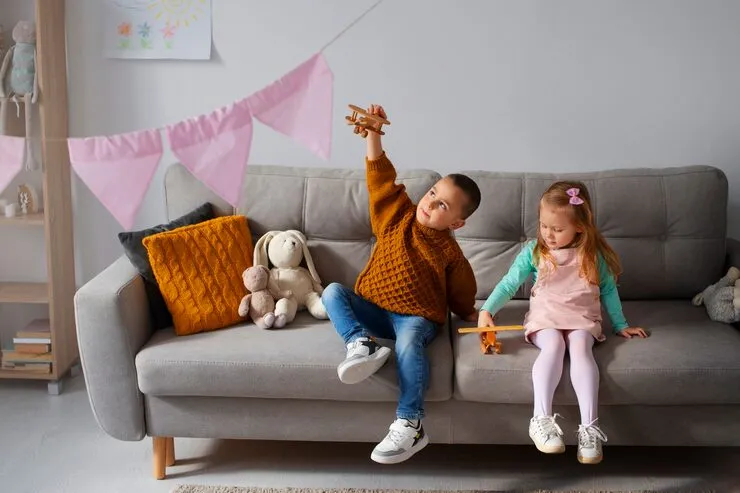
Prevention is at times the best discipline. By organizing your home and routine right you can save half the battles before they begin.
Childproofing to Reduce "Nos"
You do not want your toddler touching your expensive electronics or toddler touching the trash can, then you ought to keep them away and out of reach. It is a cliché but we usually expect toddlers to possess the strength of a superhero. In case the remote control is placed on the coffee table, then they will pick it. Conflict is minimized through reducing temptation.
The Magic of Routine and Transitions
Toddlers are creatures that like predictability. They are not afraid when they have an idea of what is ahead. We have used a visual chart in our morning routine: a picture of the toothbrush, a bowl of the cereal, shoes, a backpack. It made my son feel in control and reduced our squabbling in the morning by approximately 80 percent.
Besides, provide them with a transition warning. Rather than dragging them off the playground, say, we are going to say bye-bye to the swings in five minutes. This preset their brain to the change.
Common Toddler Triggers and Solutions
| Trigger | Why It Happens | The "Best Way" to Handle It |
|---|---|---|
| Hunger | "Hangry" is real for toddlers. Low blood sugar = low patience. | Keep healthy snacks on hand. Don't run errands right before lunch. |
| Tiredness | An overtired child has a stressed nervous system. | Respect the nap schedule. If you miss it, lower your expectations for behavior. |
| Overstimulation | Too much noise, light, or people can overwhelm them. | Find a quiet corner. Sit with them and reduce the sensory input. |
| Boredom | They act out because they need engagement. | Redirect their energy to a new, positive activity. A change of scenery works wonders. |
Why Spanking and Punishment Don't Work
I need to touch upon this because it is a question to which all parents answer at some stage of their life: Is it better to spank my child to teach him or her a lesson? The truth is, as decades of researches by the American Academy of Pediatrics and UNICEF support, no.
Spanking a child will educate him/her that hitting is acceptable. It instills fear rather than enlightenment. It destroys the faith and may cause further aggression, depression, and anxiety in the future.
Taking Care of the Parent (That's You, Mama!)
Punishing a toddler is tiresome. On some days, I thought I was not doing well since I could not retain my composure. Yet, here is the professional mainstay: you must take care of yourself in order to take care of them.
Conclusion
Calculating how best to discipline toddlers is not about having a magic wand that will turn them into perfects. It is pertaining to establishing a trust and respecting relationship. It is teaching them that mistakes are learning experiences and that you love them whether they are good or bad.
I do not always have a peaceful house. We have breakdowns over the wrong colour cup. However, now I have means to cope with it. I understand that my child requires closeness, not disapproval, when he or she is misbehaving. I understand that positive discipline is a marathon and not the sprint.
You are doing an amazing job. You are fortunate to have your toddler. And now have some coffee (drink it when it is still hot, hopefully).
Frequently Asked Questions: Best Ways to Discipline Toddlers
Q: At what age should I start punishing my toddler?
A: It is possible to begin positive behavior modeling at infancy, nevertheless, formal discipline will most likely occur during the age of 18 months to 2 years. They begin to see the cause and effect at this age. But, have your expectations small--they will not get it at once. It is time that teaches them consistency.
Q: What is the distinction between time-out and time-in?
A: A time-out is normally a seclusion of a child to reflect on whatever they have done, yet they are easily perplexed. A time-in is sitting with your child and experiencing a melt down together and co-regulating, and sharing about emotions. It emphasizes relationship and the imparting of emotion skills as opposed to punishment.
Q: My toddler strikes me when he/she is angry. How do I stop this?
A: First, stay calm. Take their hands in yours and say, I will not allow you to hit me. It is all right to be angry, not to be hurt. Instill in them an alternative behavior, such as kicking the floor or holding a pillow. Always in line with this response.
Q: What should I do to punish my toddler in the street in order not to embarrass him/her (or myself)?
A: Forget about the gawking strangers. Your focus is your child. When a meltdown occurs go down to their level, talk in soft tones and in case they need it, take them out of a situation (to the car or a bathroom). Let them not have it, or you will be teaching them that tantrums in the open air are good. Stay firm but kind .