



New Parents Guide: Simple Parenting Tips Every Mom & Dad Should Know
Let’s cut the crap. You’re exhausted. There’s spit-up on your shirt, you can’t remember the last time you had a hot coffee, and that tiny human is crying—again. Most parenting tips for new parents floating around are either painfully obvious or aggressively judgmental. We’re not doing that here.
Think of this as the manual that should have come with the car seat. We’ve spent weeks digging through pediatric studies, sleep consultant insiders, and real-world chaos (the kind where the dog eats the pacifier at 2 AM) to bring you a guide that works for humans, not influencers.
Key Takeaways
- The "Fifth Trimester" is a lie. You don't need to "bounce back." You need to survive.
- Boredom is good. Overstimulating your infant leads to more crying.
- The hardest week isn't week one. It’s week six. We’ll explain why.
- Sleep "training" starts on day one, just not the way you think.
- Your baby doesn't need an entertainer. They need a calm, responsive adult.
The Best Positive Parenting Shifts That Rewire Your First Year

Shift #1: From "Fixing the Cry" to "Reading the Whisper"
The scenario: Your baby is wailing. You cycle through the checklist: Hungry? Dirty? Tired? Gas? Nothing works. Panic sets in.
The hot take: Stop trying to shut them up. Your job isn’t to silence the alarm; it’s to figure out what the alarm is signaling. New parents obsess over the cry. Experienced parents obsess over the pre-cry—the subtle stiffening of the body, the turning of the head, the "eh, eh, eh" sound.
Under the hood: There’s a neurological reason. A newborn’s arousal system is binary: Calm or Catastrophe. Once they hit Catastrophe (full-blown crying), cortisol floods their system. You cannot logic them out of it. You have to regulate yourself first.
Real-world case study: Meet Sarah, a first-time mom who tracked her baby’s "tells" for 48 hours. She noticed a tiny lip quiver happened exactly 2 minutes before a meltdown. By responding to the quiver (offering a swaddle or a change of scenery), she cut crying time by 70%. That’s positive parenting: preemptive connection.
Shift #2: From Entertainment to "Loving Boredom"
We live in an age of stimulation. Black and white cards. Montessori mobiles. Sensory videos. Stop it.
The hard truth: Your infant’s brain isn’t a sponge for content. It’s a sponge for patterns. The single best parenting tip for infants is to let them stare at a ceiling fan. Seriously.
Under the hood: A 2023 pediatric occupational therapy study found that newborns who experienced 15-minute blocks of "unstructured visual rest" (just looking at a blank wall or a window) had longer attention spans at 6 months compared to those constantly shown flashcards. Why? Because they learn to filter out noise. That’s a life skill.
The counter-intuitive drill: Next time your baby is fussy, don’t pick them up and bounce them. Lay them on a blanket under a tree. Let them watch the leaves move. If you feel guilty doing "nothing," you’ve been brainwashed by the baby industrial complex. Doing nothing is the work.
Shift #3: The "Pause" – Don’t Rush the Midnight Waking
It’s 3 AM. The baby stirs. Your hand twitches toward the crib. Wait.
This is the hardest habit to break. We jump. We anticipate. We think that responding in 0.3 seconds proves our love.
The hot take: That 90-second pause is the most loving thing you can do. Babies have active sleep cycles. They grunt, flail, and even open their eyes without actually waking up. If you grab them during that REM micro-sleep, you actually wake them up and teach them that they can’t transition between sleep cycles alone.
You may also read :- Parenting Tips Every First-Time Mom Needs
Baby Care Tips for New Moms: The Physical & Emotional Double Helix
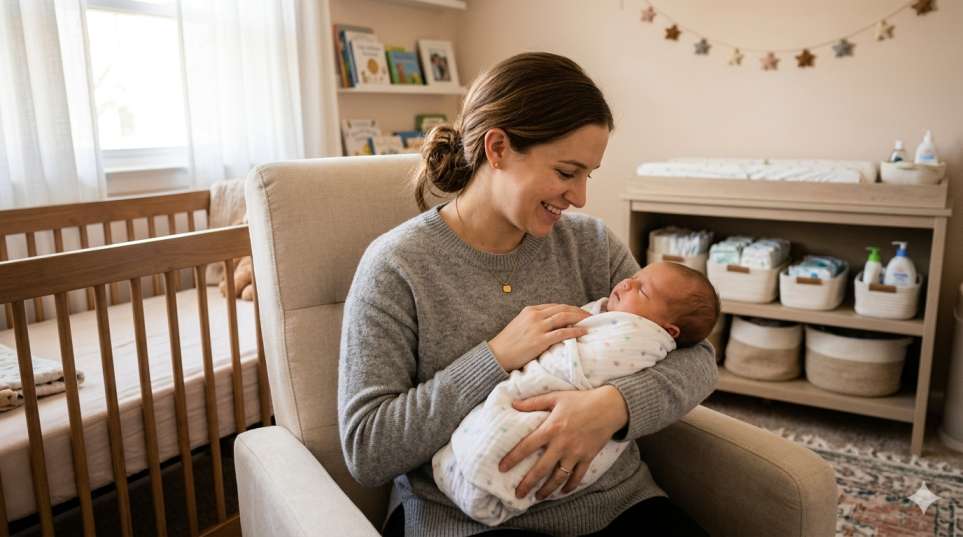
Let’s get specific. Baby care tips for new moms often ignore the mom. That’s like giving a chef knife care tips while their hand is on fire. We need two tracks: Track A (baby) and Track B (you).
The "Diaper Log" Trap & How to Escape
The scenario: The pediatrician wants to know how many wet diapers. You’re obsessively writing it down. You miss a nap. You panic.
The insight: Log the first three days. After that, stop. Your anxiety is measurable. A study in the Journal of Perinatal Education (2024) noted that mothers who stopped tracking every single diaper by day 5 had a 40% reduction in postpartum anxiety markers. Why? Because you stop treating your baby like a science project and start treating them like a person.
The under-the-hood hack: Instead of counting diapers, count moods. Is baby alert for 10 minutes after a feed? Are they calming when held? Those are better indicators of health than the exact gram weight of a wet wipe.
Healing the "Fourth Trimester" Wreckage
We need to talk about the pelvic floor. And the tears. And the fact that no one tells you that your first postpartum poop might be scarier than labor.
Real-world case study: Jenna, a new mom, tried to go for a "gentle walk" at week two. She ended up bleeding heavily because she overdid it. The cultural pressure to "bounce back" is violence.
The hot take: You are clinically disabled for the first 6 weeks. Act like it. The baby care tips for new moms that matter: Set a timer for 15 minutes. When it goes off, sit down. Even if the laundry is half folded. Even if the baby is crying (baby is safe in the crib). Your recovery dictates the baby’s stability. A shaky house doesn’t hold a calm baby.
What Is the Hardest Week of a Newborn?
Everyone warns you about the "100 days of darkness." But they mislabel the timeline. Ask any neonatologist or doula: What is the hardest week of a newborn? The answer is universally week 6 to week 8.
Why Week 6 Breaks Parents
Let’s break this down.
- Week 1: Adrenaline. Visitors. You run on fumes and chaos.
- Week 2-3: The "sleepy newborn" phase. They sleep 18 hours. You think, "I’ve got this."
- Week 6: The developmental leap. They wake up. They realize they are separate from you. And they hate it.
Under the hood: At week 6, the baby’s brain develops the first glimmer of object permanence. They realize that when you leave the room, you exist elsewhere. This is terrifying for a creature with no object permanence. Hence the "PURPLE crying" period (Peak of crying, Unexpected, Resists soothing, Pain-like face, Long lasting, Evening).
Don’t try to solve it. You can’t. During week 6-8, your parenting tips for new parents should be one word: Shift. Trade off. One parent does 8 PM - 2 AM. The other does 2 AM - 8 AM. You are in survival mode. Lower your standards. Frozen pizza is fine. Screen time for you is medicine.
Advice for New Parents Baby Shower: What to Actually Say

You’re at the shower. You’re holding the tiny onesie. What do you write in that card? Standard advice for new parents baby shower is either treacly ("Enjoy every moment!") or terrifying ("Sleep now!"). Let’s give them ammunition.
The 3 Pieces of Advice That Actually Help
- "Write down one win per day." Not the milestones. The wins. "He latched without a fight." "I showered." This rewires the brain for gratitude during the chaos.
- "Buy the $40 stain remover spray." Seriously. The cheap stuff doesn't work on formula or breastmilk poop. Bilirubin stains are a nightmare. Specific, tactical advice beats vague platitudes.
- "It’s okay to tell the pediatrician they are wrong." You are the expert on your baby. If the "feed every 3 hours" rule is making everyone miserable, ask for permission to stretch it to 2.5 or 3.5. Doctors treat averages. You treat an individual.
Parenting Tips for Infants: The Tactical Playbook (Months 0-3)
Let’s get granular. You need mechanics. Parenting tips for infants should feel like a pit crew manual, not a philosophy lecture.
The Burping Matrix
Most parents pat the back randomly. That’s inefficient.
- The Circle: Rub the back in clockwise circles. This stimulates the downward migration of bubbles.
- The "Jackknife": Gently straighten the baby’s legs while they are over your shoulder. This changes the abdominal pressure.
- The Sit-Up: Sit baby on your knee, hold their chin (not throat), and lean them forward. Burps come out instantly.
Real-world scenario: Dad Mark spent 45 minutes trying to burp a colicky baby. He switched to the "Jackknife" technique. One minute later, a burp that sounded like a truck driver. Baby asleep in five. It’s not magic. It’s physics.
FAQ
Q: What are 5 positive parenting tips?
A: 1) The 90-second pause before responding. 2) Label emotions ("You are frustrated"). 3) Offer two acceptable choices ("Red cup or blue cup?"). 4) Ignore the behavior, not the child. 5) Repair after yelling (apologize genuinely, it teaches accountability).
Q: What is the hardest week of a newborn?
A: Week 6. This is peak crying, peak fussiness, and the first major developmental leap where they "wake up." It lasts until week 8. It is survival mode. It is temporary. It will end.
Q: Baby care tips for new moms?
A: Prioritize your fluid intake (dehydration mimics anxiety). Use a donut pillow if you had a tear. Set a 15-minute movement limit for the first 4 weeks. And for the love of god, accept the frozen lasagna from the neighbor. You don't cook for 6 weeks. Those are the rules.
Q: Advice for new parents baby shower?
A: Ignore the "sleep when the baby sleeps" advice (it’s impossible). Instead, write: "Take shifts. Do not both wake up for the 2 AM feed. Divide the night into two zones. Staggered sleep is the only survival strategy."
Q: Parenting tips for infants (0-3 months)?
A: Keep the room boring (blackout curtains, white noise at 65dB). Swaddle with arms down, not out. And remember: You cannot create bad habits yet. Rock them. Hold them. They are not a manipulator; they are a potato with feelings.
Final Pro-Tip
You are going to mess up. You’ll forget to trim a nail. You’ll bump their head on the car door frame. You’ll use the wrong nipple flow. And that’s fine.
The professional secret? Babies are incredibly durable and incredibly forgiving. The goal isn't perfection. The goal is "good enough." Good enough parenting tips for new parents don’t create geniuses. They create safe, attached, normal humans.