



Home Workout Routine For Beginners Without Equipment
You do not need a gym membership, a set of dumbbells, or any fancy machine to get stronger and feel better. Your own body weight is enough. This guide gives you a clear, safe, and effective home workout routine for beginners without equipment. You will learn exactly which exercises to do, how to do them with good form, and how to make progress week after week.
Key Takeaways
- Your body is the machine. Push-ups, squats, planks, and lunges work every major muscle group when you combine them correctly.
- Start with three days per week. Your muscles need rest to rebuild. More is not better when you are beginning.
- Form comes before reps. Two good push-ups beat ten sloppy ones. Learn the movement first, then add volume.
- Progress by changing leverage and tempo. You do not need weights to make an exercise harder.
Why Bodyweight Training Works?
Resistance training does not require external load. Your body weight provides resistance against gravity. When you lower into a squat, your muscles fight gravity to stand back up. When you hold a plank, your core fights gravity to keep your spine straight .
This type of training builds strength, endurance, and muscle tone. It also improves balance and coordination because you move through space without a machine guiding you. For beginners, bodyweight training is often safer than loading a barbell because the movements are natural and the risk of joint strain is lower when form is good.
The other advantage is practical. You can do these workouts in a small living room, a hotel room, or a park. No commute, no fees, no waiting for equipment. That removes the most common barriers that stop people from exercising .
Before You Start: Three Rules for Beginners
Rule one: warm up for five minutes. Cold muscles do not stretch or contract well. Walk in place, circle your arms, do a few gentle bodyweight squats, and rotate your torso side to side. You are not trying to tire yourself out. You are raising blood flow and waking up your joints.
Rule two: quality beats quantity every time. A push-up with your hips sagging and your head cranked forward does not train your chest and triceps effectively. It trains bad posture. Learn each movement in its easiest form first. Add difficulty only when you can complete the movement with control.
Rule three: rest between sessions. Your muscles grow and adapt during recovery, not during the workout itself. Three full-body sessions per week with a rest day between each is a proven beginner schedule. Tuesday, Thursday, and Saturday work well for most people.
Read Also: 7-Day Simple Healthy Meal Plan: Quick Prep for Busy Weeknights
The Beginner Routine: Three Days Per Week
This routine uses a circuit format. You move from one exercise to the next with minimal rest, then rest after completing the full circuit. Circuit training blends strength work with light cardio, so you get both benefits in one session .
Complete two to three rounds of the circuit below. Rest sixty to ninety seconds between rounds.
Exercise 1: Bodyweight Squat
The squat trains your thighs, glutes, and lower back. Stand with your feet about shoulder-width apart. Keep your chest up and your gaze forward. Push your hips back as if you are sitting in a chair, and bend your knees. Go as low as you can while keeping your heels flat on the floor and your back straight. Push through your whole foot to stand back up.
If this feels unstable, hold onto a door frame or the back of a chair with one hand while you practice the movement.
Repetitions: 10 to 12
Exercise 2: Incline Push-Up
A standard push-up is difficult for most beginners. An incline push-up lets you build the same strength with less load. Place your hands on a sturdy surface that will not move, such as a kitchen counter, a solid table, or a wall. The higher the surface, the easier the exercise.
Keep your body in a straight line from your head to your heels. Do not let your hips sag or pike up. Bend your elbows to lower your chest toward the surface, then push away to return to the start.
Repetitions: 8 to 10
Exercise 3: Reverse Lunge
Lunges train one leg at a time, which reveals and corrects strength differences between your left and right sides. Stand tall. Step one foot backward and lower your back knee toward the floor. Keep your front knee over your ankle, not past your toes. Push through your front foot to return to standing. Alternate legs.
If balance is difficult, hold onto a wall or chair with one hand.
Repetitions: 6 to 8 per leg
Exercise 4: Glute Bridge
Many beginners have weak glutes from sitting for long hours. The glute bridge strengthens your backside and your lower back. Lie on your back with your knees bent and your feet flat on the floor, close to your bottom. Press through your heels and lift your hips until your body forms a straight line from your shoulders to your knees. Squeeze your glutes at the top. Lower slowly.
Repetitions: 12 to 15
Exercise 5: Bird Dog
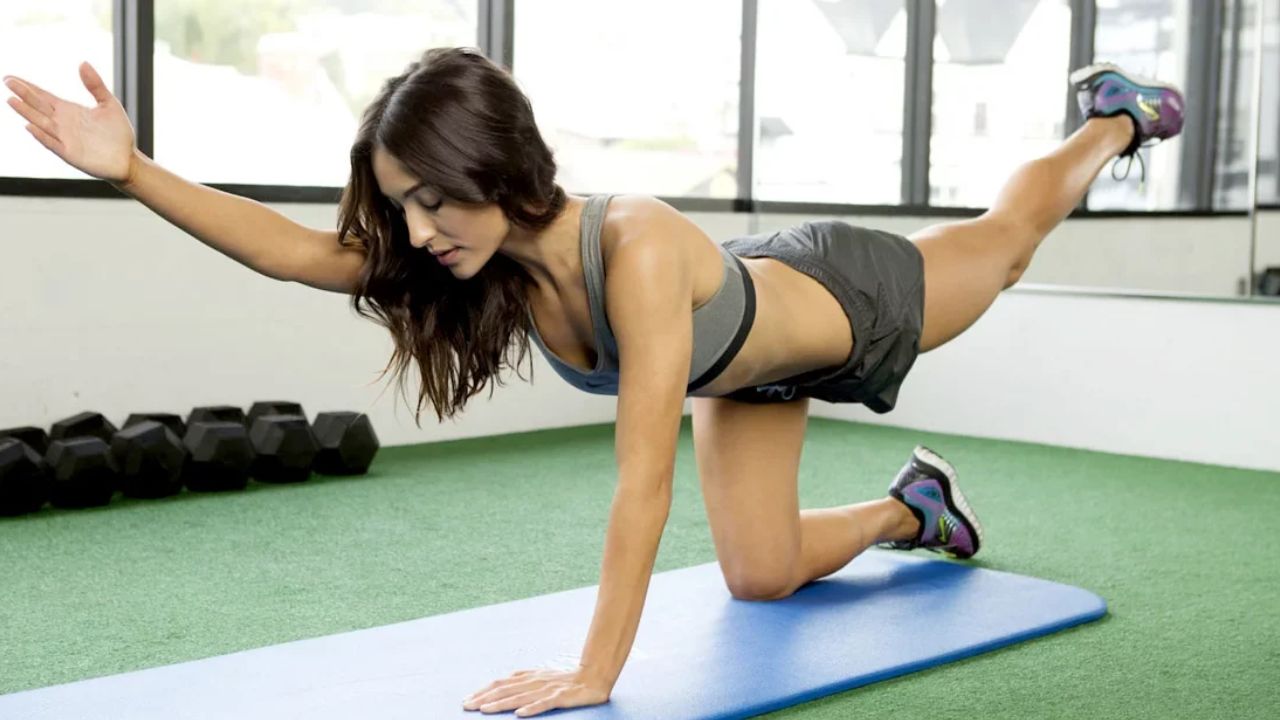
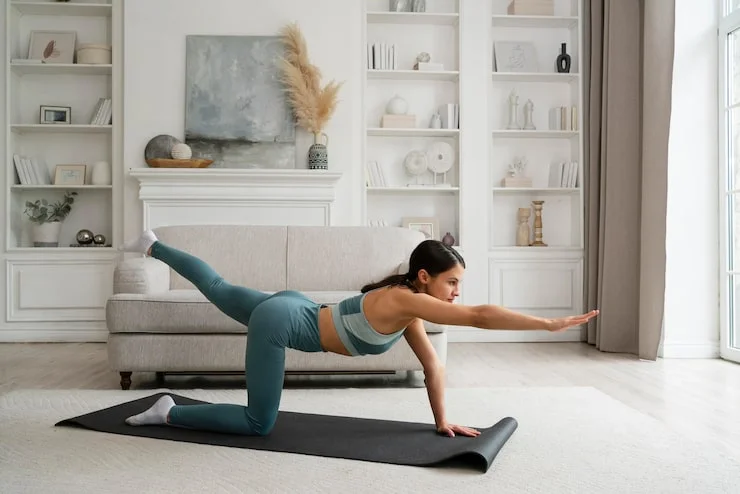
The bird dog trains your core and your back while teaching balance. Start on your hands and knees. Your hands should be under your shoulders, your knees under your hips. Slowly extend your right arm forward and your left leg backward at the same time. Keep your hips level and your spine straight. Hold for two seconds, then return to the start. Switch sides.
Repetitions: 6 to 8 per side
Exercise 6: Plank
The plank is the most direct way to train your deep core muscles. Place your forearms on the floor with your elbows under your shoulders. Extend your legs behind you and balance on your toes. Your body should form a straight line. Do not let your hips drop or lift. Breathe normally.
Duration: Hold for 20 to 30 seconds
You May Also Like: Best Exercises for Fitness and Strength: Build Power and Endurance
How to Make Each Exercise Easier or Harder?
You do not need new equipment to adjust difficulty. You change how your body moves.
To make an exercise easier: Reduce the range of motion. For squats, do not go as low. For push-ups, use a higher surface. For planks, drop to your knees.
To make an exercise harder: Slow down the lowering phase. Take three seconds to lower yourself in a squat or push-up instead of one. This increases the time your muscles spend under tension, which is a powerful driver of strength gain. You can also pause at the hardest point of the movement. Hold the bottom of a squat for two seconds before standing.
To add volume: Add one repetition per set each week. When you can do three sets of fifteen squats with good form, you are ready to try a harder variation, such as a split squat.
What About Cardio?
Your heart needs work too. You do not need a treadmill. Any movement that raises your heart rate and makes you breathe harder counts .
On your rest days, take a brisk twenty-minute walk. Walk up stairs instead of taking the elevator. Put on music and dance with your family. These small movements add up. The goal is not to exhaust yourself. The goal is to move often.
If you want a structured cardio session, try this simple interval workout twice a week on non-strength days: march in place for one minute, do ten jumping jacks, rest for thirty seconds, and repeat five times. That is ten minutes of movement that improves heart health and burns calories.
Common Beginner Mistakes to Avoid
Mistake one: doing too much too soon. Beginners often feel motivated and try to workout every day. This leads to soreness, fatigue, and quitting. Three days per week is enough for the first month.
Mistake two: ignoring pain. Muscle soreness after a workout is normal. Sharp pain during a movement is not. If a joint hurts, stop. Adjust your form or choose an easier variation.
Mistake three: holding your breath. Breathing supplies oxygen to your muscles. Exhale during the hardest part of the movement. Inhale as you return to the start.
Mistake four: skipping the warm-up. Five minutes of light movement reduces your risk of injury. It also improves your performance because warm muscles contract more forcefully.
A Sample Week for a Beginner
- Monday: Full-body circuit (the routine above), two rounds.
- Tuesday: Twenty-minute walk.
- Wednesday: Rest.
- Thursday: Full-body circuit, two to three rounds.
- Friday: Twenty-minute walk or light stretching.
- Saturday: Full-body circuit, three rounds.
- Sunday: Rest.
Follow this schedule for four weeks. On week five, add one repetition to each exercise. On week eight, replace incline push-ups with knee push-ups on the floor. Small changes over time produce real results.
Frequently Asked Questions
How long until I see results?
Most beginners notice improved energy and less stiffness within two weeks. Visible muscle tone and measurable strength gains typically appear after four to six weeks of consistent training. The key word is consistent. Three sessions per week for six weeks will do more than ten sessions in one week followed by a month off.
What if I miss a workout?
Nothing bad happens. Life gets in the way sometimes. Do not try to make up the missed session by training twice the next day. Simply continue with your next scheduled workout. Consistency over months matters far more than perfection in any single week.
Do I need to stretch after working out?
Gentle stretching while your muscles are warm feels good and can help maintain flexibility. Hold each stretch for twenty to thirty seconds without bouncing. Focus on your thighs, chest, and lower back. Stretching is not mandatory for strength gains, but many people find it helps them relax and home workout routine for beginners without equipment.
Can I do this routine if I am overweight?
Yes. Bodyweight training is adjustable. Start with the easiest variations. Use a chair for support during squats and lunges. Do wall push-ups instead of incline push-ups. The goal is to move your body through a full range of motion safely. As you get stronger and more comfortable, you can reduce the support.
What should I eat before and after?
You do not need special supplements or protein powders. Eat a normal meal one to two hours before training. Something with carbohydrates and a little protein works well, such as toast with eggs or rice with vegetables. After training, drink water and eat your next regular meal. Your body will get what it needs from real food.
Conclusion
You have everything you need to start. Your body, a small space, and twenty minutes three times per week. The routine in this guide trains every major muscle group with movements that are safe for beginners and easy to adjust as you get stronger.
Do not wait for motivation. Motivation follows action. Put on comfortable clothes, clear a space on the floor, and do one round of the circuit today. You will feel better afterward, and that feeling will carry you into the next session.